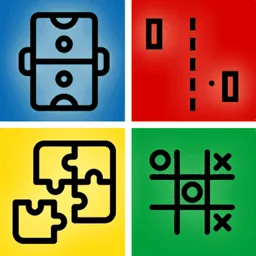
2 player games on one phone that actually work
There are two of you, one phone, and some time to kill. Neither of you wants to install the same game, make an account, and wait in a lobby to play against the person sitting right there.
Two players on one device is the oldest multiplayer format there is, and it is still the fastest one to start. It also has real rules about what fits, which is why some games feel perfect on a shared screen and others feel broken.
What makes a game survive one screen
Three properties decide it, and almost every two-player game on a phone either has all three or fails.
Everything is visible to both players. Games with a private hand of cards do not work, because the screen is a shared object. The usual workaround — passing the phone back and forth so each player looks in turn — technically functions, but it turns a five-minute game into a fifteen-minute one. Games where the whole state is public lose nothing at all.
Both players are oriented correctly. This is the one people underestimate. If the board is drawn the right way up for one player, the other is reading it upside down. The games that work either draw a mirrored interface for each end, or use a board with no natural top — a hockey table seen from above looks identical from both sides.
The controls do not overlap. Two people cannot reach for the same part of a screen at the same time without collision. Either the game strictly alternates turns, or it gives each player their own half.
The classics that transfer perfectly
Tic-Tac-Toe. Nine squares, one tap per turn, a whole game in under a minute, and no hidden information. It is the purest fit for the format.
It is also, between two adults who have both worked it out, a guaranteed draw — the game is solved, and perfect play from both sides always ends level. That reputation is fair and slightly misses the point. With a child who has not yet learned to look one move ahead, it is a genuinely good teaching game: block a threat, create two threats at once, notice that the centre square is worth more than the edges. The moment they spot their first fork is worth the twenty draws that came before it.
Air hockey. The best real-time fit there is. The table is symmetrical, so neither player is reading it upside down, and each of you defends one end with one finger. It is fast enough that a round takes under a minute and physical enough that the phone genuinely gets shoved around.
The tactical content is real, too. The common beginner mistake is chasing the puck up the table, which leaves an open goal behind you. Defending the triangle in front of your own goal and letting the puck come to you beats charging, almost every time.
Pong. One paddle each, one ball, no instructions required. It is fifty years old and still works because the rules are entirely contained in what you can see. There is nothing to learn and nothing to explain, which makes it the game to open when you are handing the phone to someone who has never played anything.
The ones that do not
Anything with a hand of cards. As above — the private-information problem has no good solution on a shared screen.
Real-time games needing two thumbs each. With four thumbs on one phone you run out of room immediately. One input per player is the practical ceiling.
Long strategy games. Chess on a phone between two people in the same room is worse than chess on any physical board, and there is no reason to prefer it. The shared-screen format is for short things.
How to sit
- Put the phone flat on a table between you. Held by one person, that person controls the angle and the distance, and they will win more than they should.
- Play a best-of, not a single round. One round of a one-minute game decides nothing, and the loser of a single game feels cheated rather than beaten. Best of five is about right.
- Agree who is which colour before the first round, not after someone scores.
- Take the phone off silent. Most of these games mark a goal or a win with a sound, and in a noisy place a silent phone means arguing about whether that counted.
The real advantage: nothing to set up
The reason this format persists is not nostalgia. It is that the setup cost is zero.
Online multiplayer needs two devices, two installs, two accounts, a connection on both ends, and a matchmaking step. Every one of those is a place where a spontaneous five-minute game dies. Sharing one screen has none of them — you are both already here, so there is nothing to connect to.
That also makes it the only format that works on a plane, on a train through a tunnel, in a car park, or anywhere the signal drops. Not because the game is cleverly cached, but because there was never anything to fetch.
Where the app fits
2 Player Games is the three games above and nothing else: Tic-Tac-Toe, Air Hockey and Pong, each drawn so both players are looking at it the right way up, each played over several rounds so there is always a rematch. It is free on iPhone and iPad, works with no connection, and has no account to make.
If there are three or four of you rather than two, that is a different problem — 1 2 3 4 Player Games is built for it, gives each player a corner of the screen, and is on Android as well.
2 Player Games
Tic-Tac-Toe, Air Hockey and Pong for two people sharing one phone. Free on iPhone and iPad, and it needs no connection.